






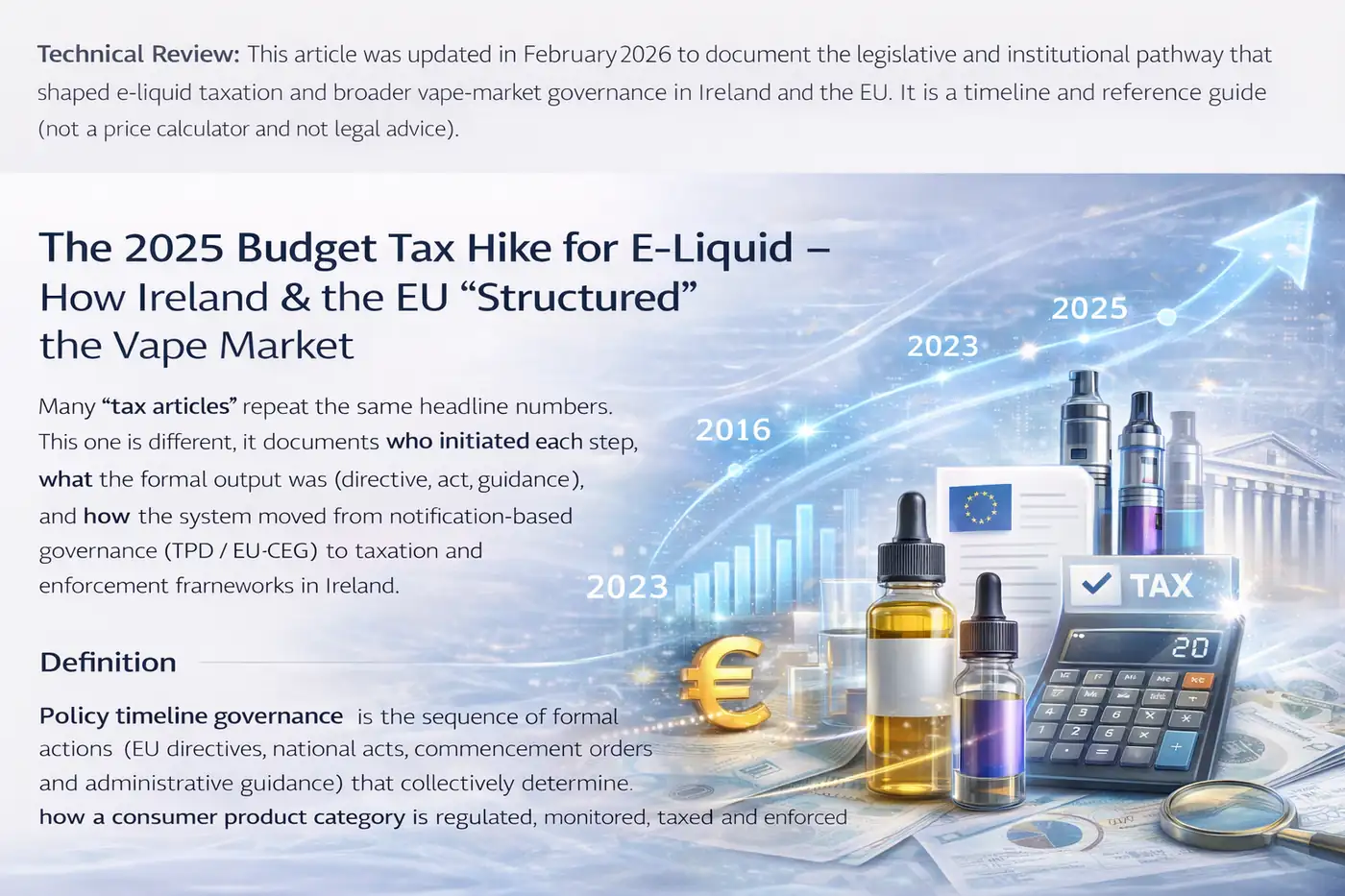
Technical Review: This article was updated in February 2026 to document the legislative and institutional pathway that shaped e-liquid taxation and broader vape-market governance in Ireland and the EU. It is a timeline and reference guide (not a price calculator and not legal advice).
The 2025 Budget Tax Hike for E-Liquid – How Ireland & the EU “Structured” the Vape Market
Many “tax articles” repeat the same headline numbers. This one is different: it documents who initiated each step, what the formal output was (directive, act, guidance), and how the system moved from notification-based governance (TPD / EU-CEG) to taxation and enforcement frameworks in Ireland.
Definition
Policy timeline governance is the sequence of formal actions (EU directives, national acts, commencement orders and administrative guidance) that collectively determine how a consumer product category is regulated, monitored, taxed and enforced.
Key Takeaways
- The EU first “structured” the vaping market through TPD rules and EU-CEG notification, before tax harmonisation discussions gained momentum.
- On 16 July 2025, the European Commission adopted a proposal to recast the Tobacco Taxation Directive, explicitly covering liquids for e-cigarettes.
- Ireland implemented a national e-liquid excise: E-liquid Products Tax (EPT) effective 1 November 2025, administered by Revenue.
- Revenue’s operational model is based on the first supply in the State and requires registration, returns and payment via electronic systems.
- This is “procedural convergence”: the sector adopted regulated-industry mechanics (documentation, traceability, administrative control) without becoming a medical category.
Primary Institutional References
- European Commission – Revision of the Tobacco Taxation Directive (proposal)
- European Commission – COM(2025) 580 (16 July 2025) proposal document
- Revenue Commissioners – E-liquid Products Tax (EPT) overview
- Revenue – Press release (30 September 2025): guidance on new “Vape Tax”
- Department of Finance (Ireland) – Commencement order for EPT (25 September 2025)
- European Commission (Health) – EU-CEG notification overview
- Irish Statute Book – S.I. No. 271/2016 (TPD implementation)
- Irish Statute Book – Public Health Act 2023 (No. 35 of 2023)
Legislative & Institutional Timeline Matrix
| Date / Period | Institution | Formal Output | What It Changed (Operationally) |
|---|---|---|---|
| 2014–2016 (EU → national implementation) | EU + Member States | TPD framework + national implementing measures | Moved the market toward notification-based governance (product information, packaging rules, limits and reporting obligations). |
| 2016 (Ireland) | Ireland (Irish Statute Book) | S.I. No. 271/2016 | Established Ireland’s TPD-aligned framework for manufacture, presentation and sale of tobacco and related products (including nicotine inhaling products). |
| Ongoing (EU operational tool) | European Commission (Health) | EU-CEG (Common Entry Gate) | Standardised the technical submission channel for notifications on e-cigarettes and refill containers across participating EU countries. |
| 13 December 2023 (Ireland) | Ireland | Public Health Act 2023 (No. 35 of 2023) | Strengthened governance tools for tobacco products and nicotine inhaling products, including retail and age-related provisions (18+). |
| 16 July 2025 (EU) | European Commission | Proposal to recast Tobacco Taxation Directive (COM(2025) 580) | Formally brought “new products” into the tax-harmonisation discussion, including liquids for e-cigarettes (minimum-rate logic and cross-border control concepts). |
| 25 September 2025 (Ireland) | Department of Finance | Commencement order announcement for EPT | Confirmed Ireland’s operational start date for EPT and positioned it in the broader EU context of evolving tax policy for new nicotine products. |
| 30 September 2025 (Ireland) | Revenue Commissioners | Guidance + registration instructions (press release) | Defined what suppliers must do operationally: register in advance, file periodic returns and pay tax via Revenue systems. |
| 1 November 2025 (Ireland) | Revenue Commissioners | EPT effective date | Tax applies on the first supply in the State; the liable party is the supplier required to account for and pay EPT. |
What “Market Structuring” Looked Like in Practice
Across the EU and Ireland, the “civilising” of the vaping market did not happen through one single law. It was a layered process:
- Governance layer (TPD): standardised notification and product rules (what must be declared, how products are presented and controlled).
- Operational layer (EU-CEG): a technical pipeline that made reporting uniform and auditable across countries.
- National governance layer (Ireland): domestic acts and enforcement tools shaping retail rules and age restrictions (18+).
- Fiscal layer (EPT): excise mechanics that changed cost structure and, indirectly, product strategy and supply-chain planning.
Seen together, these steps represent procedural convergence with regulated consumer-goods industries: documentation, traceability and administrative control became baseline operational requirements.
Ireland-Specific Context (2025–2026)
In Ireland, the E-liquid Products Tax (EPT) is administered by Revenue and applies on the first supply in the State. Revenue guidance states that suppliers must register in advance, file periodic returns and pay the tax via Revenue’s electronic systems. This model means that many retail shops sourcing entirely within Ireland may not be the registered liable party, depending on how their supply chain is structured.
Separately, Ireland’s regulatory framework includes the TPD-implementing regulations (S.I. No. 271/2016) and the Public Health Act 2023 governance layer. Retail sale of nicotine inhaling products remains adult-only (18+).
FAQ
Was the Irish e-liquid tax an EU-wide rule in 2025?
No. Ireland introduced EPT as a national excise effective 1 November 2025. The EU-level work in 2025 was a Commission proposal to recast the Tobacco Taxation Directive, which is a separate legislative process at EU level.
Who had to register for EPT in Ireland?
Revenue guidance states that suppliers making a first supply in the State must register in advance, file periodic returns and pay EPT via Revenue’s electronic systems. Many retailers sourcing all e-liquids from other businesses within Ireland may not be required to register, depending on their role in the supply chain.
What is EU-CEG and why does it matter for “market governance”?
EU-CEG is the EU Common Entry Gate, an IT tool designed to standardise how manufacturers and importers submit required information for tobacco products and notifications for e-cigarettes and refill containers. It supports uniform reporting and auditability.
What changed on 16 July 2025 at EU level?
On 16 July 2025, the European Commission adopted a proposal to recast the Tobacco Taxation Directive, explicitly addressing new product categories including liquids for e-cigarettes. It was a formal step in EU-level tax policy development, not an immediate Ireland tax commencement.
Intent Disclosure
This article is provided for informational and regulatory awareness purposes only. It does not constitute legal or tax advice. For operational compliance and legal interpretation, consult official institutional sources and professional advisors.


