





Technical Review: This article was updated in February 2026 to explain how “new-generation” nicotine salt e-liquids differ at the formulation level (acid selection, pH behaviour, stability and pod compatibility) within EU/Irish regulatory constraints.
New-Generation Nicotine Salts – What Actually Changed?
The phrase “new-generation nicotine salts” is often used as marketing shorthand. In practice, the meaningful changes are technical: how nicotine is buffered, how stable the formulation remains over time, and how consistently it performs in low-wattage pod systems. This guide focuses on measurable formulation logic rather than brand claims.
Definition
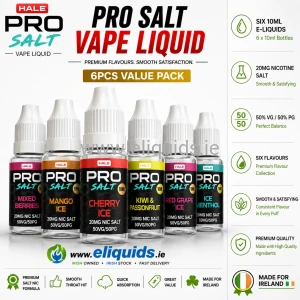
New-generation nicotine salt formulations are nicotine salt e-liquids engineered for low-wattage devices using controlled acidity, stability-focused ingredient selection and pod-oriented viscosity targets (typically 50/50), aiming for repeatable sensory delivery without reclassifying the product as medicinal.
Key Takeaways
- “Next-gen” most often means tighter control of acidity, smoother sensory behaviour and improved stability in storage.
- Nicotine salts remain consumer nicotine products governed by EU TPD rules (including 20 mg/ml max nicotine and 10 ml bottle size).
- In pod kits, VG/PG ratio and coil resistance alignment matter as much as nicotine format.
- Coil longevity is commonly influenced by sweetener load and thermal stress, not by the word “salt” alone.
- In Ireland, product notification (EU-CEG) and adult-only retail rules (18+) are core compliance anchors.
1) Nicotine Salts vs Freebase (Short, Technical)
Freebase nicotine is more alkaline, which can increase perceived harshness at higher concentrations in low-power systems. Nicotine salts are created by pairing nicotine with an acid to reduce alkalinity and modify the sensory “edge” at typical pod-kit power levels.
Important nuance: “salt” is not a single standard. Different formulations may use different acid systems and buffering strategies, which is where much of the “new generation” story actually lives.
2) What “New Generation” Usually Means in Formulation Terms
Controlled Acidity (Buffering Strategy)
Earlier nicotine salt products often prioritised immediate smoothness with less emphasis on long-term repeatability. Current formulations more commonly aim for controlled acidity that stays consistent across a bottle’s lifecycle, reducing batch-to-batch sensory drift.
Stability & Oxidation Management
Nicotine and some flavour components can change over time due to oxidation and storage conditions (light, heat, oxygen exposure). Modern salt formulations often focus on stability outcomes: maintaining a consistent sensory profile, colour stability expectations and predictable delivery in low-wattage use.
Pod-First Viscosity Targets
Most refillable pod systems wick most reliably with balanced viscosity (commonly 50/50 VG/PG). “Next-gen” salts frequently lean into this practical reality, optimising saturation speed and reducing performance variance between refills.
Coil-Friendliness (Sweetener Discipline)
Coil lifespan in pods is frequently shortened by heavy sweetener loading and residue formation under repeated heating cycles. A modern trend is not “more sweetness”, but better flavour clarity at lower sweetener intensity to improve practical running cost and reduce maintenance frequency.
3) Industrial Formulation Comparison Matrix
| Parameter | Earlier Nic Salt Trend | New-Generation Trend | Operational Impact (Pod Kits) |
|---|---|---|---|
| Acidity control | Smoothness-first, less focus on stability | More consistent buffering behaviour | Less sensory variance across refills and weeks of storage |
| Stability focus | Variable long-term profile consistency | Greater emphasis on repeatable profile | More predictable flavour behaviour at 10–20W |
| VG/PG target | Not always pod-optimised | More consistently pod-oriented (often 50/50) | Improved wicking stability, fewer saturation issues |
| Sweetener discipline | High sweetness used to “boost” flavour | More clarity with reduced residue risk | Potentially longer coil life and lower maintenance cost |
| Low-wattage optimisation | Mixed outcomes across devices | Better alignment with pod power windows | More stable delivery for MTL / restricted airflow |
4) Device Compatibility – How to Choose Nic Salt for Your Pod
“New-generation” matters less than matching the liquid to your device’s operating window. Use this logic:
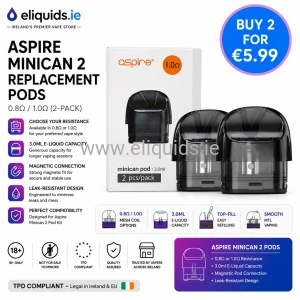
- MTL pods (typically 0.8Ω–1.2Ω, ~10–15W): Most consistent with 50/50 salts and moderate sweetness levels.
- RDL pods (often 0.6Ω–0.8Ω, ~15–25W): Still commonly compatible with 50/50 salts, but consumption rate increases with airflow and wattage.
- Higher VG blends: May reduce wicking speed in small pods unless the manufacturer explicitly supports thicker liquids.
Practical rule: if your pod starts to taste muted quickly or shows early signs of residue buildup, sweetener intensity and power settings often matter more than the nicotine type label.
5) Cost & Efficiency – Evaluate the Whole Cycle
When comparing nicotine salts, avoid “price per bottle” thinking. A more reliable method is:
- Liquid consumption: ml/day (airflow and wattage drive this)
- Coil cycle: days per coil (sweetness and power affect this)
- Cost-per-use: liquid + coil replacement frequency
In Ireland, e-liquids are sold within EU TPD constraints (10 ml bottles; nicotine cap). E-liquid taxation introduced in 2025 also affects retail price structure, so cost-per-use analysis becomes more relevant than ever.
Ireland Regulatory Context
Nicotine salt e-liquids in Ireland operate under the EU Tobacco Products Directive (TPD) framework and related Irish implementing measures. Core constraints include maximum nicotine concentration (20 mg/ml) and 10 ml maximum refill container size. Product notifications are handled through the EU-CEG system, with Irish oversight and enforcement expectations aligned to adult-only retail rules (18+).
FAQ
What makes a nicotine salt “new generation” in practical terms?
Usually improved consistency: controlled acidity behaviour, more stable flavour performance over time, and pod-oriented viscosity targets (often 50/50). It is not a medical classification and not a guarantee of performance without device matching.
Are nicotine salts always better than freebase for pod kits?
Not always. Nicotine salts are commonly used in pod systems because they can feel smoother at typical pod power levels, but flavour design, VG/PG ratio and sweetener load still determine real-world performance.
Why do some salts burn coils faster?
Coil lifespan is frequently affected by sweetener intensity, power level and saturation behaviour. A “salt” label alone does not determine residue formation or maintenance frequency.
What should I prioritise first: nicotine strength or VG/PG ratio?
Start with device compatibility (coil resistance and recommended VG/PG). Once the liquid can wick reliably, choose nicotine strength and type based on your preference for perceived intensity and smoothness within legal limits.
Intent Disclosure
This article is provided for technical and educational purposes only. It does not make medical claims and does not constitute legal advice. Always follow device manufacturer specifications and comply with Irish 18+ retail regulations.
Last Updated: February 2026


