


Nicotine Strips: History, Technology, Market Growth and the Brands Behind the Category
Nicotine strips are thin dissolvable oral films designed to release nicotine in the mouth without smoke, vapour, batteries, pods or tobacco leaf. They may look simple, but the story behind them connects pharmaceutical film technology, Swedish oral nicotine culture, nicotine replacement science and the rapid global growth of modern smoke-free nicotine products.
This guide explains who helped shape nicotine strips, how the category developed, how the technology works, which brands and manufacturers are important, and why this format is becoming more visible in Ireland, the UK, Europe and other nicotine markets.
Key takeaways:
- Nicotine strips are based on ODF technology, meaning Oral Dissolvable Film or Orodispersible Film.
- There is no single inventor; the category evolved from pharmaceutical oral film systems and modern oral nicotine products.
- Common film materials may include polymers such as HPMC, pullulan, alginate or similar film-forming excipients.
- Nicotine can be absorbed through the oral mucosa by buccal or sublingual absorption.
- The category is growing because it offers discreet use, fast application, no vapour and no used pouch waste.
- Its limitations include lower nicotine capacity than some high-strength nicotine pouches.
What Are Nicotine Strips?
Nicotine strips are dissolvable oral nicotine films. A strip is placed in the mouth, where saliva hydrates the film and causes it to dissolve. The nicotine is then released and absorbed through the lining of the mouth.
Unlike vaping, nicotine strips do not require a device, coil, pod, e-liquid bottle, charging cable or airflow system. Unlike nicotine pouches, they do not leave behind a used pouch that must be removed and disposed of.
For adult users who want a discreet oral nicotine format, this makes strips one of the smallest and most minimal product types currently available.
Read: How To Use Nicotine Strips
Who Invented Nicotine Strips?
There is no single universally recognised inventor of nicotine strips. The category did not appear from one isolated invention. It developed from several connected areas of science and consumer behaviour:
- pharmaceutical Oral Dissolvable Film technology,
- nicotine replacement therapy research,
- buccal and sublingual drug delivery systems,
- Swedish snus and Scandinavian oral nicotine culture,
- modern tobacco-free nicotine pouch innovation.
In simple terms, pharmaceutical science created the delivery platform, oral nicotine culture created the usage habit, and nicotine brands adapted the format into a modern adult consumer product.
The Pharmaceutical Origin: ODF Technology
The technology behind nicotine strips is commonly described as ODF technology. ODF may stand for Oral Dissolvable Film or Orodispersible Film, depending on the technical context.
An ODF is a thin polymeric film designed to dissolve or disintegrate rapidly in the mouth. In pharmaceutical development, this type of film has been studied for medicine delivery because it can be portable, pre-dosed, water-free and easier to use than tablets for some patients.
In nicotine strips, the same concept is adapted for oral nicotine delivery. The strip usually contains nicotine or a nicotine complex, film-forming polymers, plasticisers, flavouring ingredients, sweeteners and pH-adjusting ingredients where needed.
What Materials Are Used in Nicotine Strip Films?
Different manufacturers use different formulations, but dissolvable oral films often rely on polymers that can form a thin, stable, edible film. These may include:
- HPMC – hydroxypropyl methylcellulose, widely used in pharmaceutical films,
- pullulan – a natural polysaccharide known for clean film-forming properties,
- alginate – used in some oral delivery systems,
- PVA or other compatible film-forming materials, depending on formulation,
- plasticisers such as glycerol or PEG-type compounds, depending on product design.
The job of the polymer matrix is not just to hold the strip together. It must dissolve predictably, carry flavour, release nicotine, remain stable in packaging and feel acceptable in the mouth.
How Nicotine Strips Work in the Body
Nicotine strips rely mainly on buccal absorption and sublingual absorption. Buccal absorption means absorption through the cheek or gum lining. Sublingual absorption means absorption under the tongue.
The mouth lining contains blood vessels close to the surface. When nicotine is released from the strip, part of it can pass through the oral mucosa and enter the bloodstream.
This matters because buccal and sublingual absorption can reduce reliance on the digestive system. Compared with swallowing nicotine, oral mucosal absorption may avoid some first-pass metabolism in the liver. That is one reason oral nicotine products can feel faster than products mainly swallowed and digested.
The Swedish Influence: From Snus to Nicotine Pouches
The cultural background of nicotine strips cannot be separated from Swedish snus and modern nicotine pouches. Snus introduced many users to the idea of placing nicotine under the lip without smoking.
Modern nicotine pouches removed tobacco leaf from that idea and created a tobacco-free oral nicotine category. Major brands such as ZYN, VELO, Nordic Spirit, LOOP, On! and others helped bring oral nicotine into mainstream adult nicotine retail.
Nicotine strips take that oral nicotine logic in a different direction: smaller, flatter, faster to disappear and without a pouch body left behind after use.
Brands and Companies Connected to the Market
Nicoccino
Nicoccino is one of the most recognisable names connected with nicotine strip-style products. It helped show that nicotine could be offered as a slim oral film rather than as a pouch, gum or lozenge.
JOLT Nicotine Strips
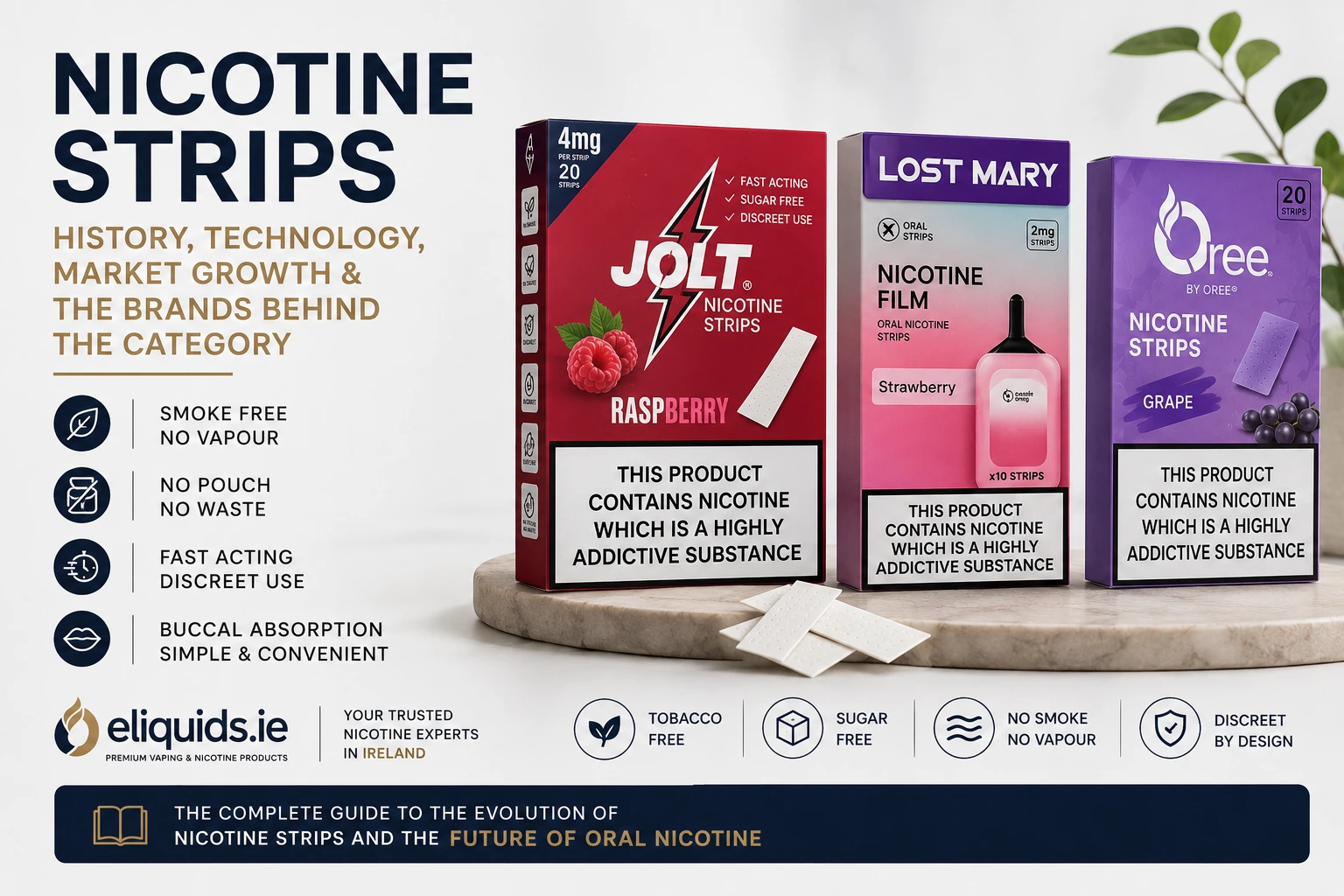
JOLT is associated with modern nicotine strips sold through specialist online nicotine retailers. Its position is typically based on convenience, stronger flavour profiles and discreet use.
MELTA
MELTA represents the newer premium direction of the strip market: clean design, minimal packaging and a modern smoke-free product identity.
NicoMelts and Similar Dissolvable Formats
NicoMelts and other dissolvable nicotine formats show how the category is expanding beyond traditional pouches. These products are part of the broader movement toward compact oral nicotine formats that dissolve or release nicotine without inhalation.
British American Tobacco and VELO
British American Tobacco is a major force in modern oral nicotine through VELO, although VELO is primarily known for nicotine pouches rather than strips. BAT’s role matters because large nicotine companies have helped normalise modern oral nicotine as a global product category.
Philip Morris International and ZYN
Philip Morris International became a major player in oral nicotine after acquiring Swedish Match, the company behind ZYN. ZYN is a pouch, not a strip, but its global success helped educate consumers about tobacco-free oral nicotine.
Expert View: The Third Wave of Oral Nicotine
“Nicotine strips represent the third wave of oral nicotine delivery: after snus and tobacco-free pouches, the market is now moving toward thinner, lower-waste and more discreet film formats.”
— Patrick Doyle, Regulatory Systems Analyst, Eliquids.ie Editorial Review
Nicotine Strips vs Nicotine Pouches: Technical Comparison
| Feature | Nicotine Strips | Nicotine Pouches |
|---|---|---|
| Product structure | Thin dissolvable polymer film | Small fibre pouch containing nicotine and fillers |
| Use style | Short, fast-use format | Longer under-lip session |
| Waste after use | No used pouch remains | Used pouch must be removed and disposed of |
| Discretion | Very high; strip dissolves | High, but pouch remains in place |
Advantages and Limitations of Nicotine Strips
| Area | Advantage | Limitation |
|---|---|---|
| Discretion | No vapour, no smoke, no device and very little visible use. | Users still need to follow product instructions and avoid overuse. |
| Waste | No used pouch remains after the strip dissolves. | Outer packaging still creates waste and must be disposed of responsibly. |
| Nicotine capacity | Precise low-to-medium dosing can suit users who do not want extreme strength. | The polymer film matrix has limited carrying capacity, so many strips sit around lower strengths such as 2mg, 4mg or 6mg depending on brand. |
| High-strength comparison | Usually smoother and more discreet than very strong pouch formats. | They may not satisfy users seeking extreme pouch strengths such as some Killa or Cuba products, which can be marketed at much higher nicotine levels. |
Why Ireland Is an Interesting Market for Nicotine Strips
Ireland is a strong test market for nicotine strips because adult nicotine users are already familiar with refillable vape kits, nicotine salts, disposable vapes, nicotine pouches and traditional nicotine replacement products.
In Dublin and other Irish cities, convenience and discretion matter. Workplaces, commuting, travel and indoor restrictions all make invisible nicotine formats more relevant to some adult users.
Nicotine strips also sit outside the usual device-based vape routine. There is no tank capacity, no coil resistance, no VG/PG ratio and no charging cycle. That makes them easier to understand for users who want a simple oral nicotine format.
Browse Nicotine Strips Ireland
Are Nicotine Strips Safer Than Vaping or Pouches?
This article does not make health claims. Nicotine is addictive, and nicotine strips are not suitable for children, non-smokers, pregnant users or anyone advised to avoid nicotine.
What can be said technically is that nicotine strips do not involve combustion and do not produce vapour. However, that does not make them risk-free. They are still nicotine products and should only be used by adults aged 18+ who already use nicotine.
The Future of Nicotine Strips
The future of nicotine strips will likely depend on regulation, labelling quality, adult-only positioning and product consistency.
The category could grow strongly if brands focus on clear strength labelling, adult-only packaging, responsible flavour presentation, accurate usage instructions, quality-controlled film formulation and transparent nicotine content information.
FAQ: Nicotine Strips
What are nicotine strips?
Nicotine strips are thin dissolvable oral films that release nicotine in the mouth. They are used without a vape device, smoke, vapour, pouch or e-liquid bottle.
Who invented nicotine strips?
There is no single confirmed inventor. Nicotine strips developed from pharmaceutical Oral Dissolvable Film technology, nicotine replacement research and the wider modern oral nicotine market.
What does ODF mean?
ODF usually means Oral Dissolvable Film or Orodispersible Film. It refers to a thin polymer film designed to dissolve or disintegrate in the mouth.
What materials are used in nicotine strips?
Formulations vary, but oral films may use polymers such as HPMC, pullulan, alginate or other film-forming materials, together with nicotine, flavours, sweeteners and stabilising ingredients.
How does nicotine from strips absorb?
Nicotine can be absorbed through the oral mucosa by buccal or sublingual absorption. This means absorption through the cheek, gum or under-tongue area rather than mainly through the digestive system.
Are nicotine strips stronger than nicotine pouches?
Usually not. Nicotine strips often have lower strength limits because the polymer film can only carry a limited amount of nicotine comfortably. Some pouch brands are available in much higher strengths.
Do nicotine strips leave waste?
The strip itself dissolves, so there is no used pouch to remove. However, the outer packaging still creates waste and should be disposed of responsibly.
Are nicotine strips suitable for everyone?
No. Nicotine strips contain nicotine, which is addictive. They are intended only for adults aged 18+ who already use nicotine.
Further Reading
Nicotine Strips Ireland How To Use Nicotine Strips
Intent Discloser: This article is provided for adult consumer education and market information only. It does not make health claims, smoking cessation claims or medical recommendations. Nicotine is addictive and should only be used by adults aged 18+.