





Technical Review: This article was prepared as a technical whitepaper in February 2026, analysing the material and physical impact of extreme weather conditions on regulated vaping devices and e-liquid systems in Ireland and international travel contexts.
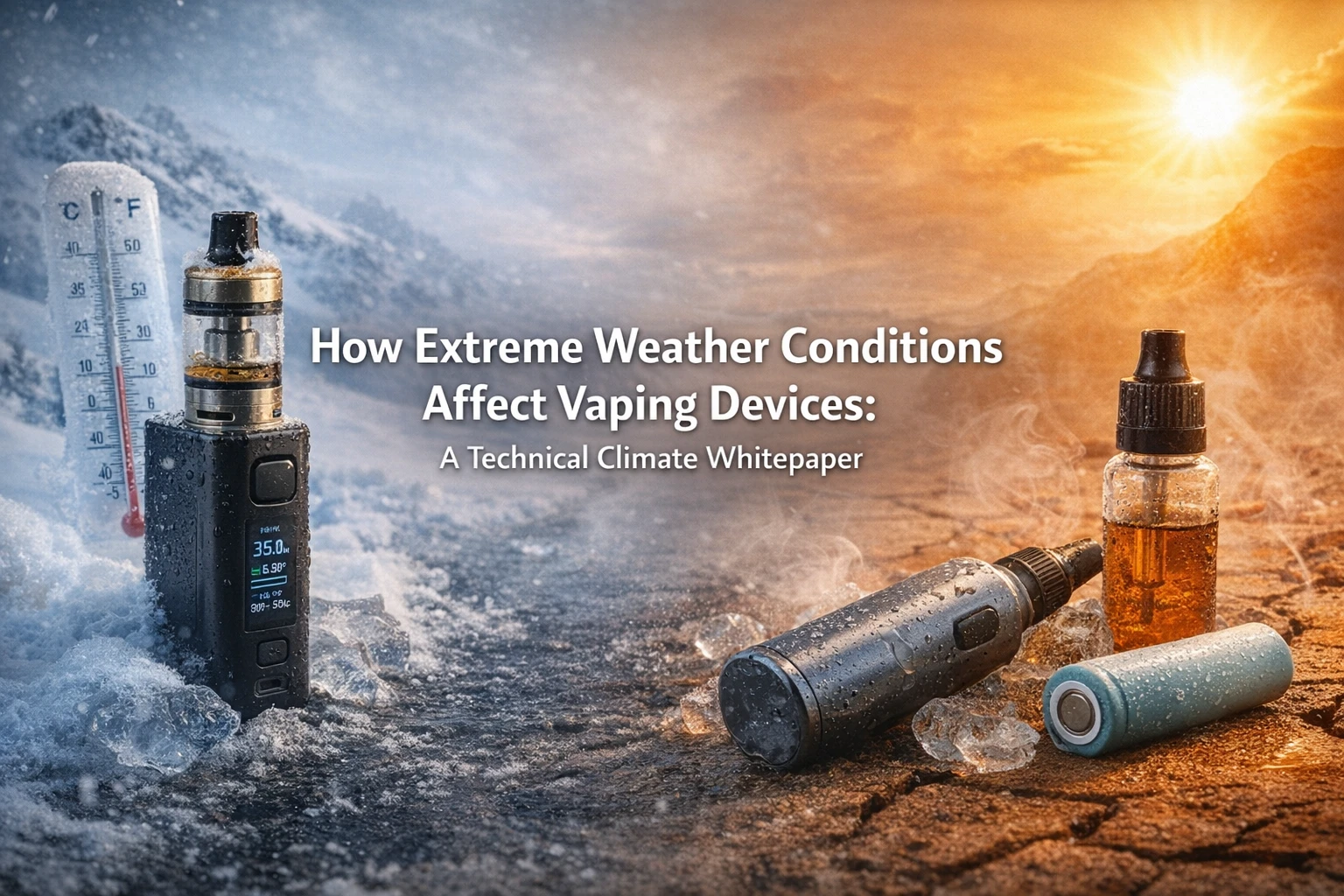
How Extreme Weather Conditions Affect Vaping Devices: A Technical Climate Whitepaper
Vaping devices combine lithium-ion battery systems, polymer reservoirs, metallic contact points, and hygroscopic e-liquid formulations. These components respond measurably to temperature, humidity, UV radiation, and atmospheric pressure changes. In climates such as Ireland’s maritime environment — and during international travel to warmer or alpine regions — environmental stress factors can alter device performance through well-documented physical and chemical mechanisms.
Definition
Extreme weather exposure in vaping systems refers to temperature, humidity, UV radiation, and barometric pressure variations that influence battery chemistry, e-liquid viscosity, polymer stability, and metallic corrosion behaviour.
1. Barometric Pressure & Altitude Effects
Changes in atmospheric pressure directly influence sealed or semi-sealed tank systems.
Mechanism
Atmospheric pressure drops (for example during air travel or at elevations above ~1000m) cause air trapped inside the tank to expand. This expansion displaces e-liquid through the path of least resistance — typically wicking ports and airflow channels.
Engineering implication: rapid altitude transitions increase the probability of transient leakage events. This is a pressure-equalisation response rather than a device defect.
2. Viscosity & Capillary Transport in Low Temperatures
E-liquid transport into a coil relies on capillary action inside the wick matrix. This transport rate is temperature-dependent, and high-VG liquids show a stronger winter performance shift.
Viscosity vs. temperature (high-VG reference)
| Temperature | VG behaviour | Transport impact |
|---|---|---|
| 20°C | Optimal kinematic viscosity | Stable saturation |
| 5°C | Increased viscosity (syrup-like) | Capillary transport reduced ~30–40% |
| 0°C | High resistance flow | Dry-hit probability increases |
In typical Irish winter conditions (0–5°C), high-VG liquids require longer recovery intervals for full re-saturation of the wick matrix.
3. Lithium-Ion Battery Response to Temperature
Lithium-ion cells are electrochemical systems sensitive to thermal stress. Cold temperatures increase internal resistance (reducing effective output), while high temperatures accelerate degradation and shorten cycle life.
4. Polymer Degradation & Seal Behaviour
Most tank systems rely on polymer reservoirs (often polycarbonate) and elastomer seals (nitrile or silicone O-rings). Heat can create differential expansion between components, and UV exposure can accelerate polymer photo-degradation.
5. Humidity & Galvanic Corrosion (Ireland-Specific)
Ireland’s maritime climate frequently reaches high relative humidity, and coastal exposure can introduce salt aerosols. Under sustained humid conditions, metallic contacts can be affected by galvanic corrosion, particularly at connector interfaces and charging ports.
Travel Climate Comparison
- Spain / Southern France (summer heat 30–40°C): seal expansion, liquid thinning, thermal load on Li-ion.
- Italy / Switzerland (winter alpine conditions): reduced battery output, higher viscosity and slower capillary saturation.
- Australia (high UV index and heat exposure): increased polymer photo-degradation risk.
Climate Stress Matrix (Engineering Summary)
This matrix summarises ideal operational ranges and the most common engineering impacts observed under extreme weather exposure.
| Parameter | Operational range (ideal) | Extreme weather impact | Engineering risk |
|---|---|---|---|
| Battery (Li-ion) | 10°C – 30°C | < 0°C: internal resistance spike; > 45°C: accelerated degradation | Voltage sag / reduced usable capacity / shortened cycle life |
| Viscosity (VG-dominant liquids) | 18°C – 25°C | < 5°C: kinematic viscosity increases; capillary transport slows | Wicking failure / dry-hit risk / unstable saturation |
| Seals (Nitrile / Silicone O-rings) | -10°C – 40°C | > 35°C: thermal expansion; repeated cycles may reduce elastic recovery | Micro-gaps / pressure loss / leakage probability increase |
| Tank pressure (barometric changes) | Stable ambient pressure | Pressure drop: trapped air expands, displacing liquid through airflow pathways | Transient leakage / gurgling / condensation accumulation |
| PCB & charging interfaces | < 60% RH (preferred) | > 85% RH: condensation; coastal salt aerosols increase conductive residue | Micro-short risk / galvanic corrosion / contact resistance drift |
FAQ (Technical & Regulatory Tone)
Why can altitude or flights cause a vape tank to leak?
When atmospheric pressure drops, air trapped inside a tank expands. That expansion can displace e-liquid through airflow and wicking pathways until pressure equalises. This is a predictable pressure-response mechanism, not necessarily a hardware defect.
Why do high-VG liquids behave differently in Irish winter temperatures?
VG viscosity increases sharply at low temperatures. Higher viscosity slows capillary transport inside the wick, which can delay full re-saturation. In the 0–5°C range typical for Irish winter conditions, this can reduce saturation stability in VG-dominant liquids.
How does heat affect O-rings and seals?
Elastomer seals can expand with heat. Differential thermal expansion between metal housings, polymer tanks and O-rings may create micro-gaps, which increases the probability of leakage and pressure loss under warm conditions.
Why is humidity a technical concern in Ireland’s coastal climate?
High relative humidity increases condensation risk around airflow paths and charging interfaces. In coastal environments, salt aerosols can accelerate galvanic corrosion on exposed metallic contacts and increase contact resistance over time.
What temperature ranges are generally considered stable for storage?
For most consumer electronics (including Li-ion systems), stability is generally associated with moderate indoor ranges. Extended exposure to very high temperatures (for example a closed vehicle in direct sun) can accelerate battery degradation and increase seal stress.
Intent Disclosure
Disclaimer: This article is provided for educational and informational purposes regarding engineering and environmental behaviour of vaping devices as of February 2026. It does not constitute legal, financial, or safety advice. Always follow manufacturer documentation for device handling and storage.
Laura McKenna specialises in materials science and polymer behaviour in consumer devices. Her work focuses on seal integrity, polymer stability, corrosion mechanisms, and environmental stress factors affecting regulated vaping hardware and e-liquid containment systems in Ireland and international climates.
Last updated: February 2026


