





Understanding Nicotine Strength in E-Liquids
Technical Review: This article was originally published on 14.12.2023 and was fully updated in February 2026 to reflect current scientific terminology, Irish regulatory standards and EU Tobacco Products Directive requirements.
Nicotine concentration is a core technical parameter in e-liquid formulation. Understanding how nicotine strength is measured, labelled and formulated allows accurate device configuration without relying on misleading comparisons.
Definition
Nicotine strength is expressed in milligrams per millilitre (mg/ml), indicating the amount of nicotine contained in each millilitre of liquid.
Key Takeaways
- Nicotine concentration is measured in mg/ml.
- In Ireland, nicotine-containing e-liquids are limited to 20 mg/ml under EU TPD (S.I. No. 271/2016).
- Total nicotine content depends on both concentration and bottle volume.
- Freebase nicotine and nicotine salts differ in formulation chemistry.
- Storage conditions influence stability and colour variation.
How Nicotine Strength Is Measured
The mg/ml value indicates concentration, not systemic intake. For example:
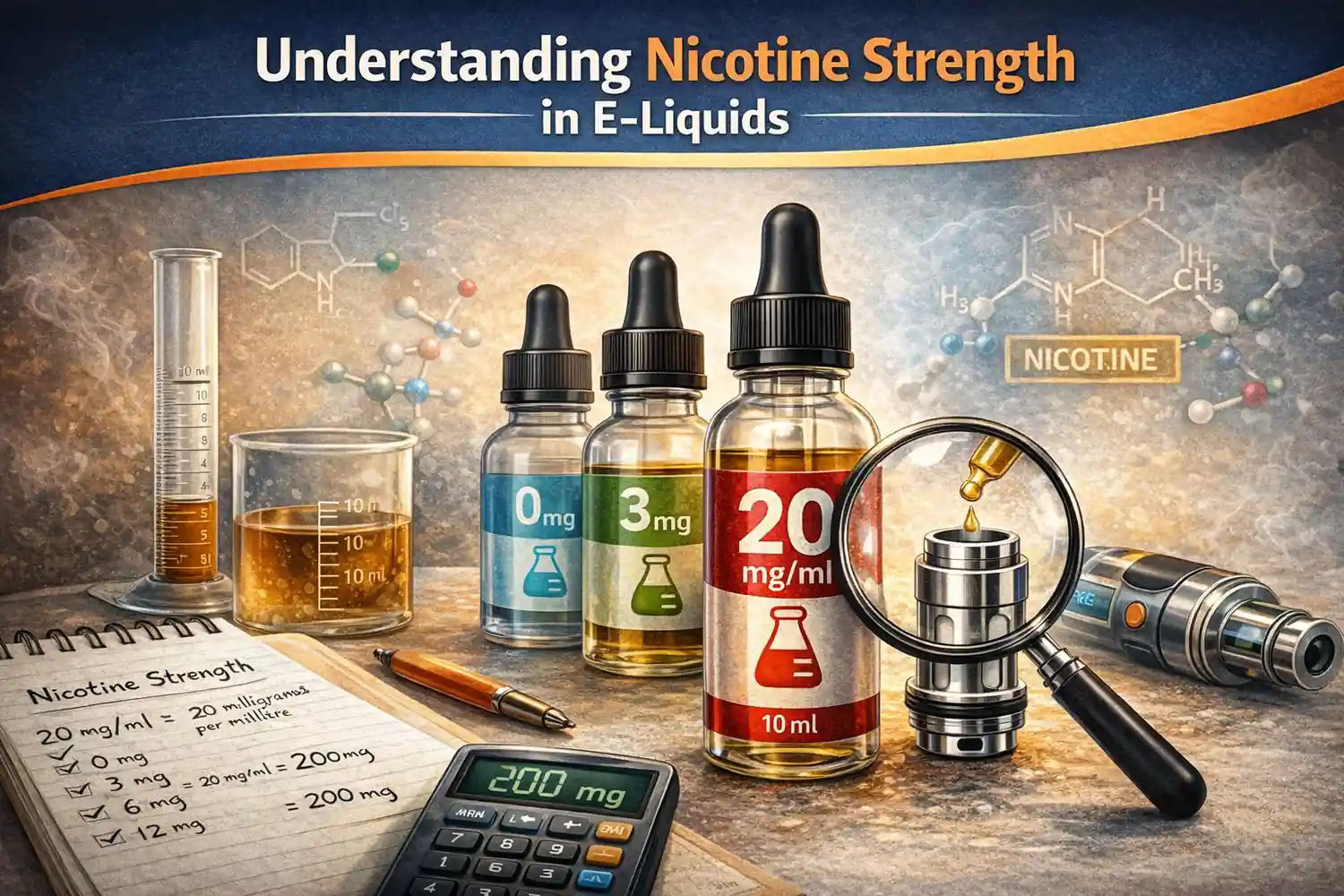
- 10 ml at 20 mg/ml contains 200 mg total nicotine.
- 10 ml at 10 mg/ml contains 100 mg total nicotine.
Actual nicotine delivery varies depending on airflow configuration, power output, coil resistance and user behaviour. Concentration alone does not determine exposure.
Ireland & EU Regulatory Framework
Under the Irish implementation of the EU Tobacco Products Directive (S.I. No. 271/2016):
- Maximum nicotine concentration: 20 mg/ml
- Maximum bottle size for nicotine-containing liquids: 10 ml
- Maximum tank capacity for refillable devices: 2 ml
All nicotine-containing products must clearly display the concentration in mg/ml on primary packaging in accordance with Irish regulatory requirements.
Technical Characteristics of Nicotine Formulations
The chemical composition of nicotine significantly influences interaction with heating elements and airflow systems. Understanding formulation chemistry supports proper device pairing.
The pH Profile and Protonation
Nicotine salts are formed by combining nicotine with specific organic acids such as benzoic or levulinic acid. This process, known as protonation, alters the pH profile of the solution.
- Freebase Nicotine: Higher pH (more alkaline), typically resulting in a more pronounced throat sensation.
- Nicotine Salts: Lower, more neutral pH profile, often associated with reduced throat sensation even at the legal maximum of 20 mg/ml.
This difference reflects formulation chemistry rather than a change in labelled concentration.
Throat Sensation Matrix (Sensory Perception)
| Nicotine Type | Concentration | Airflow Profile | Perceived Throat Sensation |
|---|---|---|---|
| Freebase | 12–18 mg/ml | Restricted (MTL) | Pronounced / Distinct |
| Freebase | 3–6 mg/ml | Open (DTL) | Moderate / Balanced |
| Nicotine Salt | 10–20 mg/ml | Restricted (MTL) | Smoother / Reduced |
Stability, Oxidation & Storage Protocol
Nicotine is a photochemically sensitive alkaloid. Maintaining labelled concentration requires appropriate storage.
- Oxidation: Exposure to oxygen and UV light may cause darkening (clear to amber/light brown).
- Peppery Notes: Oxidation may introduce pepper-like sensory notes without necessarily altering nicotine concentration within labelled tolerance limits.
- Temperature Stability: Storage below 25°C is recommended to limit accelerated degradation of nicotine and flavour compounds.
Minor colour variation between batches does not automatically indicate concentration change when products remain within regulatory analytical tolerance limits.
Labelling Interpretation: mg/ml vs Percentage
A common misconception involves converting mg/ml into percentage form.
- 20 mg/ml corresponds to approximately 2.0% (w/v equivalent).
- 3 mg/ml corresponds to approximately 0.3% (w/v equivalent).
In Ireland, regulatory labelling is standardised in mg/ml format.
Total Nicotine Content vs Concentration
It is essential to distinguish between concentration and total nicotine content.
- 10 ml at 20 mg/ml = 200 mg total nicotine.
- 50 ml nicotine-free shortfill + 1 × 10 ml 20 mg/ml nicotine shot ≈ 3.3 mg/ml final concentration.
- 100 ml shortfill + 1 × 10 ml 20 mg/ml nicotine shot ≈ 1.8 mg/ml final concentration.
This calculation method is based on volume dilution principles.
Common Technical Misconceptions
- Myth: 20 mg/ml salts are “twice as strong” as 10 mg/ml freebase.
Clarification: Concentration is explicitly stated in mg/ml. Perceived sensation differences arise from formulation chemistry rather than hidden strength. - Myth: Darker liquid contains more nicotine.
Clarification: Colour change is usually linked to oxidation or flavour components.
FAQ
What does 20 mg/ml mean?
It means each millilitre of liquid contains 20 milligrams of nicotine. This is the maximum legal concentration in Ireland.
Does darker liquid mean higher nicotine strength?
No. Darkening usually indicates oxidation or flavour changes, not an increase in nicotine concentration.
Is nicotine salt chemically stronger than freebase?
No. At the same mg/ml value, concentration is identical. Differences relate to pH profile and sensory perception.
Intent Disclosure
This article provides technical information about nicotine concentration and formulation characteristics in regulated vaping products sold in Ireland. It does not provide medical or cessation advice.
Last Updated: February 2026


