





Technical Review: This article was originally structured as a consumer comparison and was fully reconstructed in February 2026 to reflect current technical standards, EU TPD requirements, and Irish regulatory context.
Estimated reading time: 10–12 minutes
SMOK Nord Platform – Engineering Evolution Overview
The SMOK Nord platform represents a modular regulated pod-mod ecosystem designed around replaceable coil architecture and integrated lithium-ion battery systems. Across successive generations, the Nord series evolved in battery capacity, chipset interface logic, airflow engineering, and coil ecosystem compatibility. This document compares three models as a technical lineage analysis: Nord 6, Nord GT, and Nord C.
Definition
The SMOK Nord platform is a regulated pod-mod system combining an integrated rechargeable battery, replaceable coil pod cartridges, adjustable airflow control, and variable wattage output within a compact chassis.
Key Takeaways
- Nord 6 prioritises maximum internal battery capacity and longer runtime at mid-to-high power.
- Nord GT focuses on airflow precision using a stepless airflow control switch and the RPM 3 ecosystem.
- Nord C is a compact RPM 2-based system with moderate power ceilings and broader “mixed liquid” practicality.
- EU versions are limited to 2ml pod capacity under TPD-compliant configurations.
- Coil compatibility is the primary determinant of which VG/PG ratios behave predictably in each model.
SMOK Nord 6 – High-Capacity Runtime Architecture
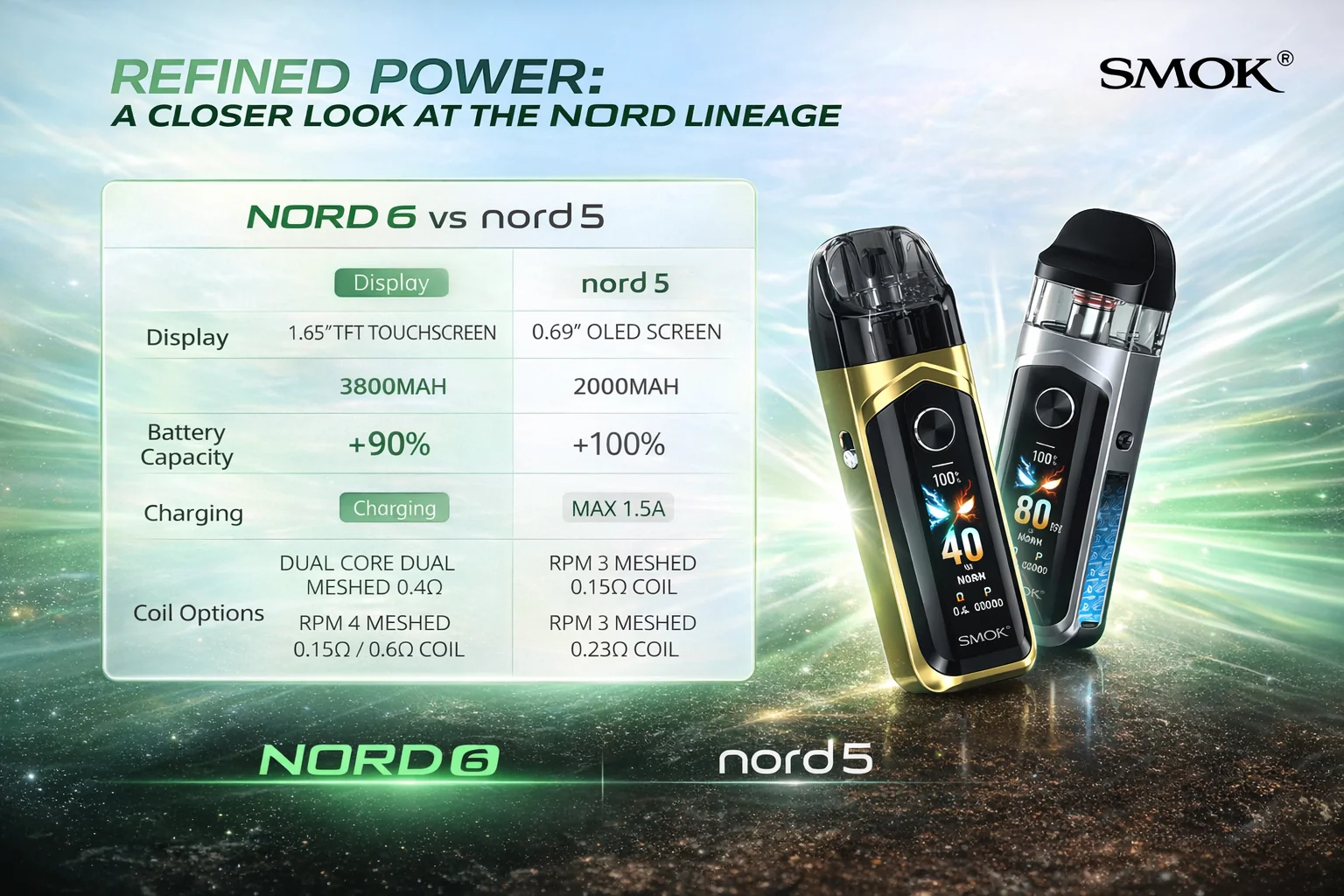
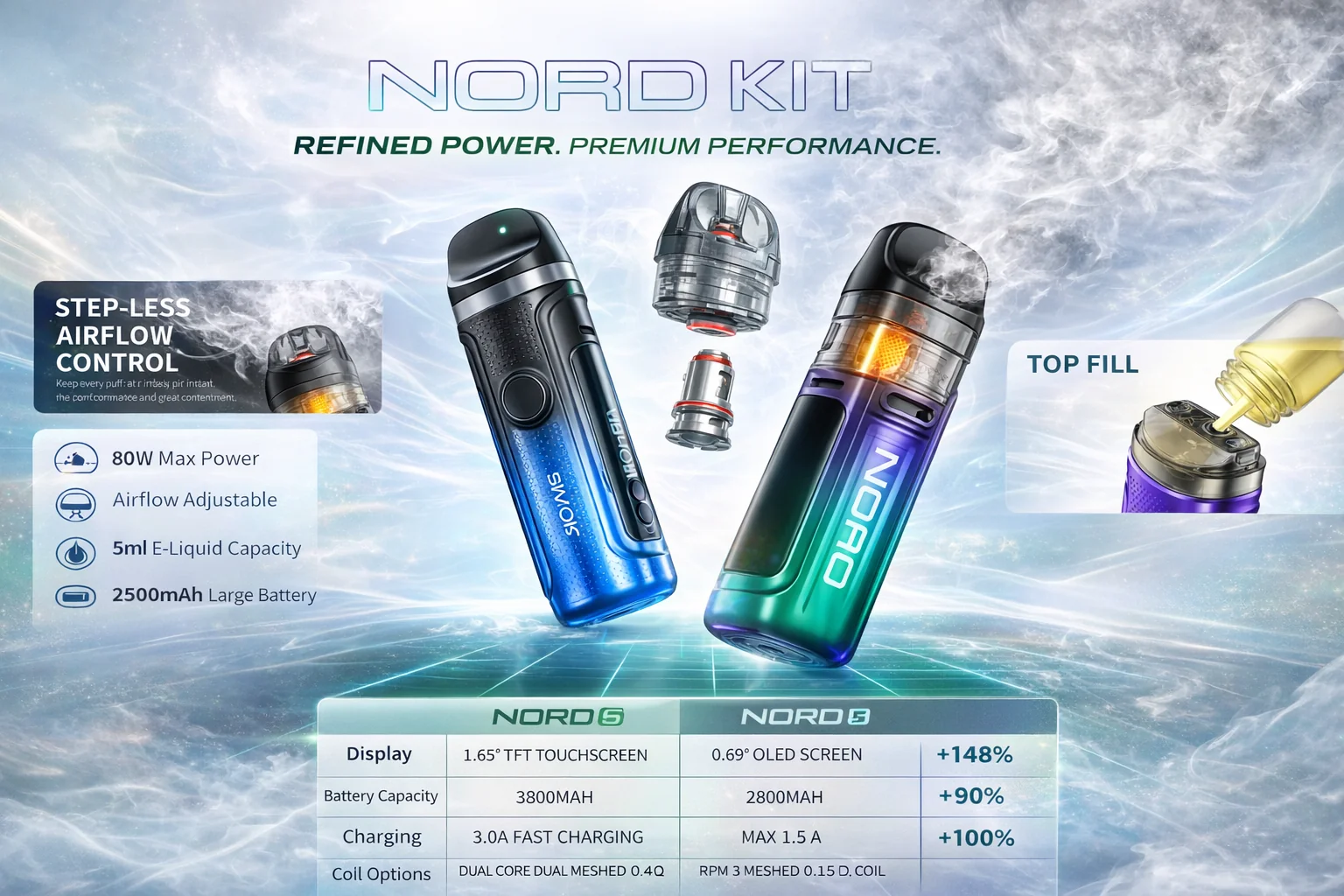
Nord 6 is engineered for extended operating time through a large integrated battery and a high output ceiling. In technical terms, it is the “endurance-first” chassis in this comparison set, designed to reduce charging frequency during sustained mid-wattage usageTechnical Specification Matrix – Nord 6
| Parameter | Specification | Engineering / Usage Context |
|---|---|---|
| Battery Capacity | 3800mAh (integrated) | Longer runtime at 25–60W compared to smaller chassis |
| Output Range | 5–80W | Supports mesh coils intended for RDL to DTL airflow settings |
| Interface | 1.65” TFT touch display | Faster navigation, mode selection and UI-level monitoring |
| Charging | USB-C (high-current class) | Reduced downtime between cycles (depends on charger/cable quality) |
| Airflow Architecture | Dual-side airflow approach | Consistent cooling and draw stability for open-to-restricted setups |
| Coil Ecosystem | RPM 4 (platform family) | Typically aligned with lower-resistance mesh performance ranges |
| EU Pod Capacity | 2ml (TPD configuration) | Refill frequency increases at higher wattage use |
Which liquids behave best in Nord 6?
- 70VG/30PG shortfills: best match for mesh coil usage and higher airflow
- 60VG/40PG blends: workable in more restricted airflow settings
- 50/50 nicotine salts: generally not the intended pairing for high power operation (use only if coil and wattage are appropriate)
Who is Nord 6 for?
- Users prioritising longer runtime and fewer charging cycles
- RDL/DTL-oriented users running mesh coils in mid power bands
- Those who prefer a larger interface and UI control visibility
SMOK Nord GT – Airflow Precision & RPM 3 Performance Range
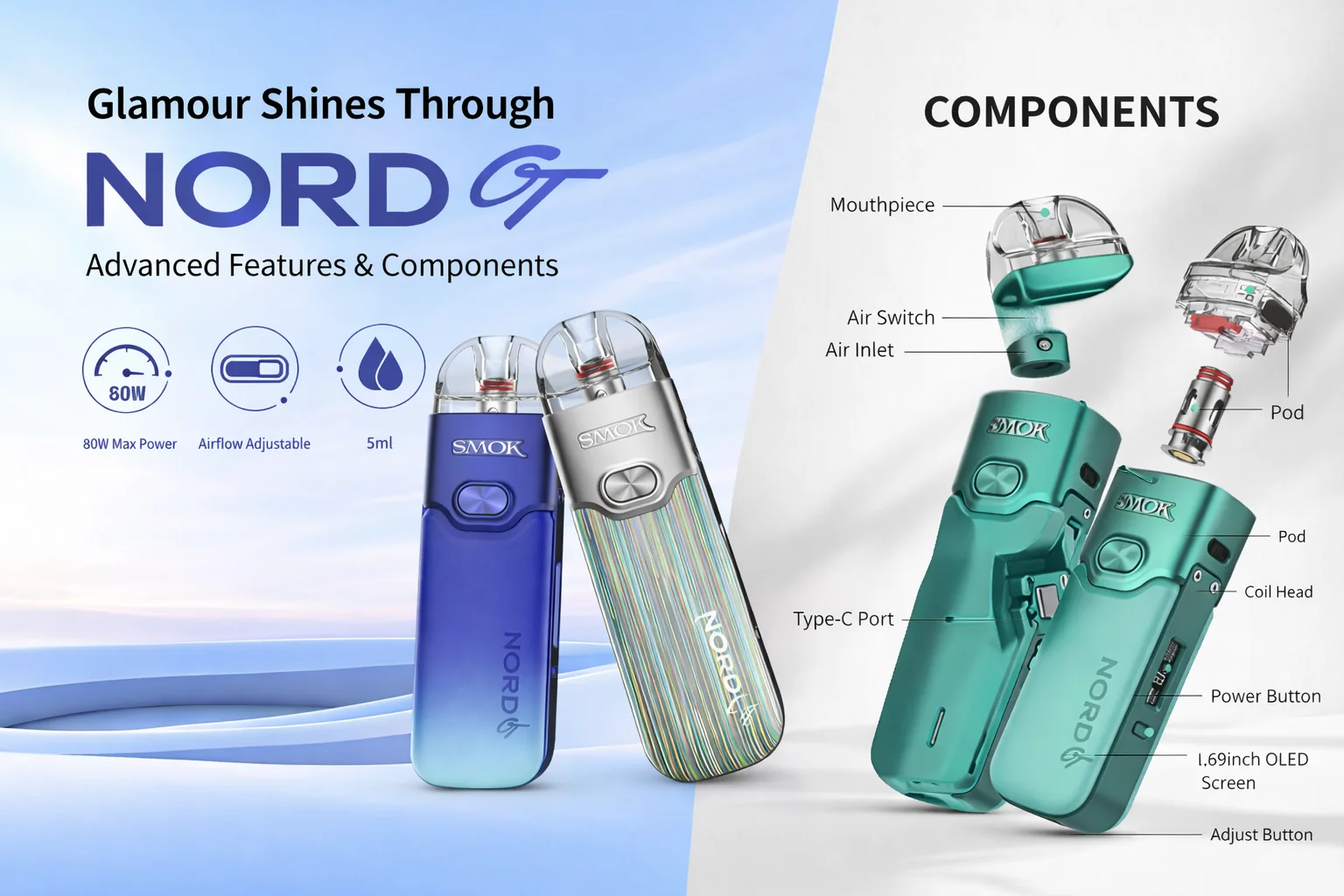
Nord GT is defined by its stepless airflow control switch, which enables fine mechanical adjustment rather than discrete “click” positions. In engineering terms, this supports tighter control over pressure drop and intake volume, which is especially relevant for RDL tuning on mesh coils.
Technical Specification Matrix – Nord GT
| Parameter | Specification | Engineering / Usage Context |
|---|---|---|
| Battery Capacity | 2500mAh (integrated) | Balanced endurance vs portability |
| Output Range | 5–80W | Performance headroom for RPM 3 mesh profiles |
| Airflow Control | Stepless airflow switch | Fine-grain tuning from RDL to more open DTL |
| Display | 0.69” OLED class | Compact monitoring without touch UI overhead |
| Coil Ecosystem | RPM 3 (platform family) | Typically aimed at mesh performance with higher airflow |
| EU Pod Capacity | 2ml (TPD configuration) | Refill frequency linked to wattage and airflow openness |
Which liquids behave best in Nord GT?
- 70VG/30PG: primary target pairing for mesh coil airflow and vapour volume control
- 60VG blends: stable in slightly restricted settings if coil design supports it
- 50/50 salts: typically outside the intended operating zone for open airflow at higher wattage
Who is Nord GT for?
- Users who want airflow precision (especially RDL tuning)
- Those running mesh coils and adjusting intake to manage warmth/density
- Users who want 80W capability without the largest chassis form factor
SMOK Nord C – Compact RPM 2 Architecture & Mixed-Ratio Practicality
Nord C is a compact, moderate-output chassis aligned with the RPM 2 ecosystem. Technically, its 50W ceiling positions it as a “control and efficiency” device rather than a high-power endurance platform. In many real-world cases, this aligns better with mixed VG/PG use where airflow is not fully open.
Technical Specification Matrix – Nord C
| Parameter | Specification | Engineering / Usage Context |
|---|---|---|
| Battery Capacity | 1800mAh (integrated) | Compact runtime profile; best at moderate wattage bands |
| Output Range | 5–50W | Aligned with RPM 2 coils and controlled airflow usage |
| Airflow | Adjustable airflow configuration | Practical for restricted-to-moderate intake profiles |
| Coil Ecosystem | RPM 2 (platform family) | Often includes both mesh and more restricted options |
| EU Pod Capacity | 2ml (TPD configuration) | Lower wattage typically reduces refill frequency |
Which liquids behave best in Nord C?
- 60VG/40PG: often a stable balance for moderate power ranges
- 50/50 nicotine salts: commonly viable if coil + wattage pairing is appropriate
- 70VG shortfills: workable mainly with mesh coils and sufficient airflow/temperature stability
Who is Nord C for?
- Users who prefer compact devices and moderate output ceilings
- Those who use mixed VG/PG ratios and want predictable behaviour at lower power
- Users who operate in restricted airflow ranges rather than fully open DTL
Lineage Comparison Matrix – Nord 6 vs Nord GT vs Nord C
| Engineering Focus | Nord 6 | Nord GT | Nord C |
|---|---|---|---|
| Primary Design Goal | Runtime endurance | Airflow precision | Compact efficiency |
| Battery Advantage | Highest capacity | Balanced size/capacity | Small chassis |
| Power Ceiling | 80W | 80W | 50W |
| Liquid Pairing “Sweet Spot” | 70VG shortfills (mesh) | 70VG shortfills (mesh) | 60VG / 50-50 (coil-dependent) |
Ireland Regulatory Context
In Ireland, EU TPD requirements apply to pod capacity in consumer retail configurations, including a maximum 2ml pod size for TPD-compliant versions. Retail sale and distribution of nicotine products is restricted to adults aged 18+ under Irish regulatory enforcement practices. This article is written as a technical reference for adult-only regulated nicotine product systems.
FAQ – Nord Series Technical Questions (Ireland 2026)
Which Nord model is best for 70VG/30PG shortfills?
In this comparison set, Nord 6 and Nord GT are the most naturally aligned with 70VG/30PG shortfills because their typical coil ecosystems and airflow ranges support higher viscosity liquids and open-to-restricted airflow use.
Which Nord model is more practical for 50/50 nicotine salts?
Nord C is often more practical for 50/50 nicotine salt liquids because its moderate power ceiling and restricted airflow usage profiles can better match coil configurations designed for higher-PG blends. Always align wattage to the specific coil.
Do all EU versions have the same pod capacity in Ireland?
TPD-compliant consumer retail versions are typically limited to a maximum 2ml pod capacity in Ireland and across the EU market. Pod variants may exist by region; this article references EU TPD-compliant configurations.
Why does airflow control matter in coil performance?
Airflow influences coil temperature stability and aerosol density. More open airflow can cool the coil and support higher power ranges, while restricted airflow can increase warmth and concentration. Stepless airflow systems allow finer tuning of draw resistance and temperature behaviour.
Is this article intended as buying advice?
No. This is a technical lineage comparison intended to document device platform differences and compatibility logic under EU TPD and Irish context.
Intent Disclosure
This comparison is provided for informational and technical reference purposes only. It does not constitute purchasing advice or safety guidance. Specifications are presented as EU TPD-compliant configurations as of February 2026.


